




Overweight and obesity have a significant impact on both health and economy at every level of society. The latest scientific research indicates obesity is no longer considered simply a lifestyle-related disease, but is a complex condition caused by a combination of multiple sociological, psychological and biological factors. Today, most of the world’s population lives in countries where overweight and obesity contribute to more deaths than undernutrition.
Obesity affects people of all ethnicities and populations worldwide. Certain ethnic and racial groups appear to be particularly predisposed (Pima Indians of Arizona), Pacific Islanders (Polynesians, Micronesians, Maori), and African Americans and Hispanic populations (Mexican or Puerto Rican in origin) in North America are particularly prone to obesity.
Overweight and obesity rates have been increasing worldwide for decades. According to the World Health Organization1, obesity has almost tripled since 1975. In 2016, more than 1.9 billion adults over the age of 18 were overweight. Of these, over 650 million were obese. Among adults over the age of 18, 39% were overweight in 2016, and 13% were obese.
Obesity is also prevalent in childhood. Over 340 million children and adolescents aged 5 to 19 were obese in 2016. Of particular concern is that even the youngest, under the age of 5, are not spared from this pandemic, as many as 38 million children under the age of 5 were overweight or obese in 2019.
Obesity is increasingly present in our country as well. Data from the Institute of Public Health of the RM from 2017 show that 62.7% of men and 48.4% of women over the age of 18 are overweight, and 19.6% and 17.2% of them are obese, respectively2.
Definition of obesity
“Obesity is not only a disease in itself, but also an indicator of other diseases.” These words are attributed to the ancient Greek physician Hippocrates, who lived 2,400 years ago and is considered the father of medicine. His definition is very similar to the modern one, according to which obesity is a chronic, progressive disease with a tendency to relapse. It may begin in early childhood and continue with progressive increase, especially in puberty or later in life.
Obesity is an excessive accumulation of body fat. The main cause lies in the increased intake and decreased consumption of calories. This means an increased intake of high-calorie foods, fast food, large meals, foods rich in fats and sugars, sweet juices with a lot of sugar and preservatives, insufficient intake of fruits and vegetables, and at the same time an increase in physical inactivity due to excessive TV watching and computer use, video games, etc. Of course, the sedentary way of working and transportation, as well as accelerated urbanization, contribute to the reduced physical activity.
The degree of nutritional status is assessed using the Body Mass Index (BMI), calculated as body weight in kilograms divided by the square of height in metres (Table 1).
| WHO classification | BMI (kg/m2) |
| Underweight | <18.5 |
| Normal weight | 18.5–24.9 |
| Overweight | 25.0–29.9 |
| Obesity Class I | 30.0–34.9 |
| Obesity Class II | 35.0–39.9 |
| Obesity Class III | ≥40.0 |
Table 1 – BMI Classification
As shown in the table, a BMI greater than 25 is classified as overweight, while a BMI greater than 30 is classified as obesity. A BMI above 35 is considered severe obesity, and a BMI above 40 is considered morbid obesity. A normal body weight is defined as a BMI between 18.5 and 25.
There are gender differences in the distribution of adipose tissue. In women, body fat is predominantly distributed in the lower part of the body, around the hips and buttocks, and is referred to as gynoid obesity (pear-shaped body). In men, body fat is more commonly distributed in the upper part of the body, around the shoulders, chest and abdomen, and is referred to as android or visceral obesity (apple-shaped body). Visceral obesity (central obesity) is associated with an increased risk of developing other diseases. Therefore, its assessment is important and is performed by measuring waist circumference. In men, waist circumference should not exceed 94 cm, while in women it should not exceed 80 cm. An increased waist circumference is associated with a higher risk of numerous obesity-related comorbidities and complications.
Complications of obesity
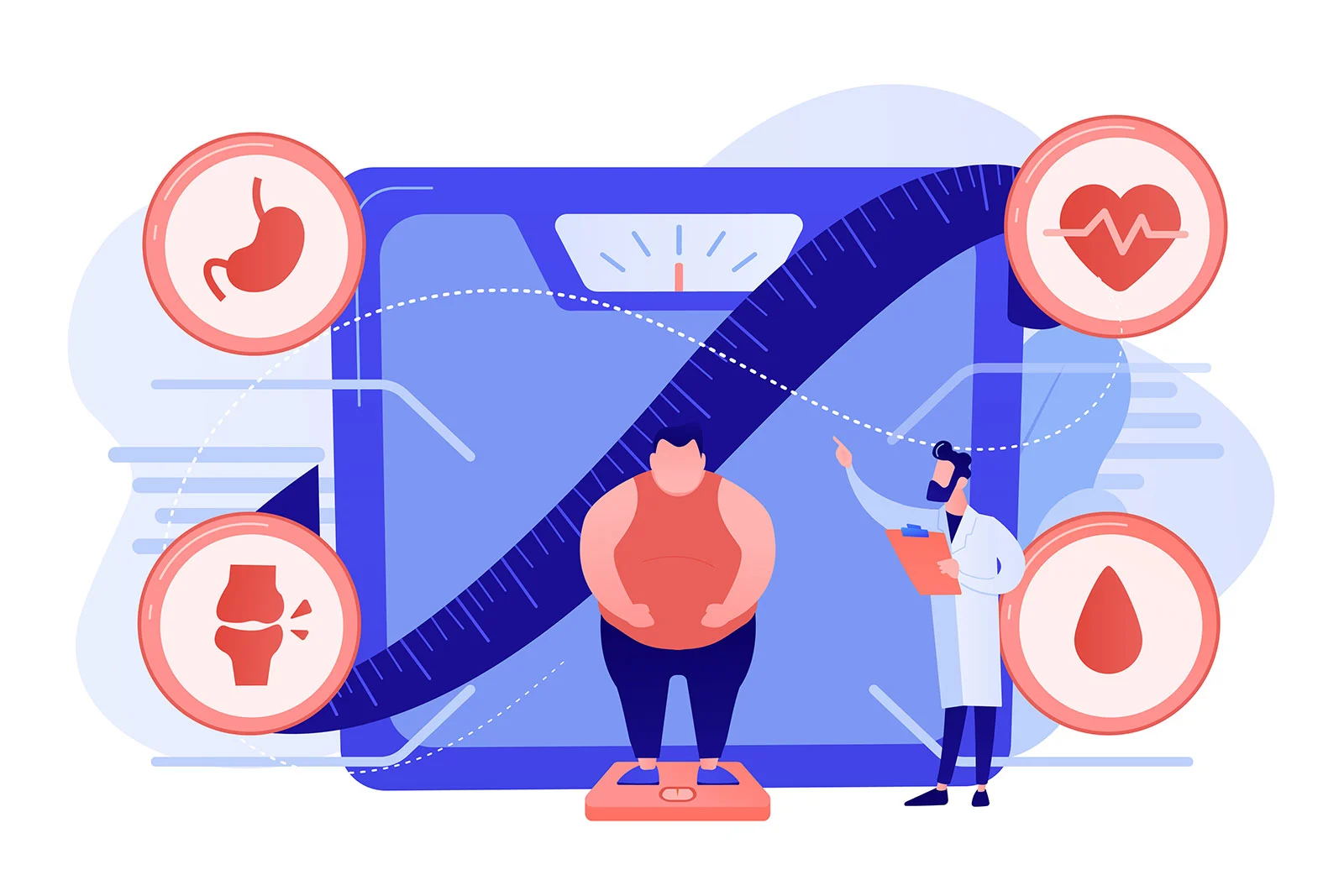
Obesity is associated with more than 200 complications, the most common of which include cardiovascular disease, type 2 diabetes mellitus, prediabetes, fatty liver disease, gallstones, cancer (oesophageal, gastric, colorectal, liver, pancreatic, breast, uterine and ovarian cancer), hypertension, asthma, stroke, pulmonary embolism, as well as polycystic ovary syndrome and infertility.
For some types of cancer, the risk is significantly higher compared with people of normal body weight (for example, the risk of oesophageal cancer is seven times higher). A study3 published in 20093 demonstrated that obesity carries the highest risk for the development of type 2 diabetes mellitus, particularly among women. Obesity also affects the joints by placing excessive strain on them, contributing to knee pain, back pain and osteoarthritis. It also affects psychological well-being and contributes to the development of depression.
Obesity is also associated with reduced life expectancy. Studies suggest that increased BMI is associated with reduced life expectancy by up to 10 years. For every increase of BMI above 25 kg /m2, there is a 30% increase in total mortality4.
The COVID-19 pandemic also points to a clash of “two pandemics.” Current evidence suggests that obesity is a risk for a more severe form of COVID-19 infection, as well as a worse outcome compared to people of normal weight.
Effects of weight loss
Weight loss in individuals with obesity leads to changes in appetite-regulating hormones, resulting in an increased feeling of hunger and appetite which may persist for up to one year after the reduction in body weight (BW). On the other hand, the benefits of weight loss are numerous, including a reduced risk of diabetes and cancer, improved blood pressure control, and better psychological well-being. Achieving weight loss and maintaining it over the long term are essential for people with obesity in order to preserve overall physical and mental health and improve quality of life. To achieve this goal, all recommended treatment options for obesity should be considered, including lifestyle modification, dietary changes and physical activity, pharmacological treatment, and bariatric surgery.
References:
- WHO – obesity https://www.who.int/health-topics/obesity#tab=tab_1 , accessed December 2020
- Spiroski I, Nutrition, public health, status, policies and challenges Archives of Public Health, vol.* No.1 2016
- Guh et al. BMC Public Health 2009; 9:88
- Whitlock G, Lewington S, Sherliker P, et al. Body-mass index and cause-specific mortality in 900 000 adults: collaborative analyses of 57 prospective studies. Lancet. 2009; 373:1083–1096